A little known fact about me is that the first short story I sold was science fiction, and that I published a magazine of CHRISTIAN science fiction in 1992. Apex! - not to be confused with the current Apex magazine, which happens to also be a magazine of science fiction and horror.
My Apex! was a novice attempt to spread the word about science fiction based on a Christian worldview. It got a lot of interest. One of the authors feature was Orson Scott Card. It sold in local bookstores, and I was interviewed on a local radio show called Beyond Reason. The authors and stories were listed in Locus's database. So a reasonably big splash.
That went nowhere. I stopped publication, but continued to write science fiction. Then life happened, and I wound up going in a completely different direction.
But I was coming at it from the science fiction side. Not the Christian fiction side. At the time, Christian fiction wasn't a presence in my life. And despite what some Christian authors have stated openly to me, the SF people welcomed me. They may not have even been interested in the religious aspect of the works, but they had no problem with them either.
So I have been watching the efforts of folks to bring more attention to Christian spec fiction from the Christian side of publishing with a lot of interest. With more time, I'd be more involved in Realm Makers. I've had some great chats with Jeff Gerke, Mike Duran, Amanda Luedeke, and others. I LOVE encouraging authors to pursue this direction, if that's where their hearts lead.
So, yes, the news from January 1st caught my eye. I'm watching both Steve's positioning (here) and some of the responses (here and here) closely. I have my own strong opinions on what Steve kept from MLP . . . and what he didn't. For now, I plan to keep those to myself. As an editor, I'm interested in acquiring adult SF, and my press can probably take on more mature themes than some others.
Publishing is undergoing a seachange. Digital, obviously, is driving some of this, but I also think the readership for Christian fiction will expand, as we make more readers aware that we write a lot more than Amish and light romance. Although I love both of those categories and respect those authors, I do think we need to find a way for more readers to discover the other aspects of our field.
Discoverability remains both the question and the hurdle. And I firmly believe that SF is in a prime place to dovetail with the digital changes to raise awareness for ALL of Christian fiction. So, yes, I'm watching all the recent kerfuffle closely. With plans for the future.
Wednesday, January 8, 2014

Wednesday, September 11, 2013
Abingdon Press Manuscript Guidelines
Abingdon Press publishes 20-24 fiction titles each year. Our focus is on contemporary romance, historical romance, women’s fiction, suspense/thrillers, and speculative/visionary fiction. We do not publish Young Adult books or novels based on spiritual warfare, apocalyptic, or “end times” themes.
We only accept submissions from established agents and writers who meet with the editor at writers conferences.
We seek well-developed and original plots that are subtly layered with spiritual themes and ethical virtues. The characters must be complex and diverse people who experience faith, doubt, joy, loss, freedom, addiction, and more. Plots, conversations, and scenes should focus on the emotional aspects of relationships but should not include physical descriptions of sexual activity; voyeuristic or excessive descriptions of violence; “shock language” that profanes the worth of human beings or other living creatures.
A Few Tips for New Authors
• Manuscripts should be complete and between 85,000 and 90,000 words in length.
• Please be able to pitch your story in 25 words or less.
• Please be able to pitch yourself as an author in 25 words or less.
• Before you arrive at a pitch session, please be able to answer the following questions about your story:
o Why will the reader fall in love with your lead character(s)?
o What is the lead character’s primary goal in the book?
o Who (or what) opposes the goal? Why?
o What’s at risk if the goal is not accomplished?
o How has the lead character changed by the end?
Tuesday, July 16, 2013
Cover Shoot, Part 1
Shooting a book cover involves a lot of folks.
Most of the Abingdon Fiction covers are composite layouts designed using stock photos, appropriate type fonts, and graphic elements. We employ some of the best designers in the business, but one element that they often have trouble finding are photographs that work with a book's story. Especially historical romances.
There are some things Photoshop just can't fix.
So this season we decided to shoot our own models for two of our covers: Myra Johnson's Whisper Goodbye (featured today) and Karen Barnett's Out of the Ruins (next time).
Whisper Goodbye is set in post-WWI Hot Springs, Arkansas, and Myra's heroine is a young, girl-next-door redhead named Mary. Pamela Clements, Associate Publisher for Abingdon's Christian Living and Fiction lines (and thus my boss), recruited one of her daughter's friends, Grace, to place the role of "Mary." Grace was perfect!
We hired Jason Dodson of Created Images as the photographer. I met Jason when I was teaching American Lit at Nossi College of Art a few years ago, and his portrait and fashion work impressed me (and continues to do so). He hired a make-up artist and hair stylist who had worked with him on previous fashion shoots.
Then I went to a local costume house, Performance, that I had worked with when I was doing community theater. I pulled a WWI nurse's uniform and cap. On Monday, July 1, we all went to work.
Hair and make-up took about 90 minutes. Then Jason begins giving his assistant Jeremy and Grace instructions. Jeremy, also a skilled photographer added some helpful suggestions as well.
This is Jason, our make-up artist (who was AWESOME), Pamela Clements, and Grace.

The hair stylist responds to the request to make Grace's up-do fluffier. Mary has thick curly hair that she has to keep pinned up on the job.

More instructions to Grace about what to do in order to produce the right facial expressions. Jason is extremely good with suggestions on what to think and how to tense certain muscles to render the right look.

A make-up touch-up. Mary didn't need to look TOO made up. Lighter lipstick shades weren't readily available in the early 20s, and the darker shades would make "Mary" look too "tarty." We wanted a look that said, "I care about my appearance, but I'm not vain or crazy about make-up."
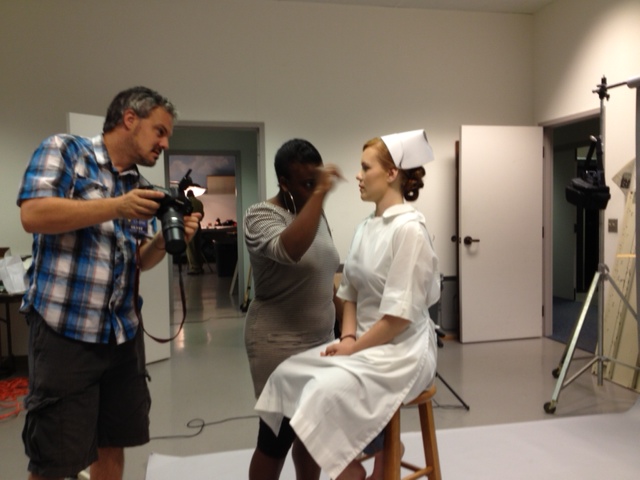
Jeremy performed all kinds of gyrations to hold reflectors in just the right place to produce the right shadows on Grace. Notice the big clip at Grace's waist? She's TINY! We had to clip her uniform so that it would stay in place and fit her correctly in front.

Everyone's watching.


Of the dozens of shots Jason took, we chose this one as our final.

And how it looks on the cover.

And here are the first two books in Myra's "Till We Meet Again" series.

This is a series that we're really excited about launching. Set just as the First World War is ending, it follows what happened to the people who struggled to return to lives and loves forever changed by what they'd been through.
Next time: Out of the Ruins!
Thursday, June 27, 2013
Why I've Started Posting Flash Fiction
Every now and then, I'll be posting a flash fiction piece on my author/editor Facebook page. I love flash fiction; it's like a refreshing dip that you treat yourself to in the middle of a hot day. A little step into a breeze.
Flash fiction is also a great training tool. To make it clear, flash fiction is NOT an abbreviated story. It's a finished story, with a complete plot structure, full characterization, and a nice beat at the end. As with every story, some are better than others. But writing in order to convey an enjoyable and satisfying tale in less than 100 words, the process can sharpen and amp up your skills for longer pieces.
As with all stories, some are better than others. Some of mine will be better than others.
Mostly I do it because I have an endless supply of ideas, and some are more conducive to quick tales than novels. They tend to bubble over at times, so I thought I'd put them to good use. Through the years, I've discovered there's always something new just over the horizon. Especially the next idea.
(I should probably note at this point that I have more than 300 unsold short stories in a box at home and four times that many rejection letters for them. Almost as many on my computer. My "graduate training" in fiction has been pretty extensive.)
I hope you enjoy them.

Friday, May 3, 2013
Why I'm Killing My Website
Sometime in the next week or so, my website at www.ramonarichards.com will disappear. This wasn't an easy decision to make, but it is one I've contemplated for a long time.
First, I want to emphasize that this has nothing to do with my website designer and host, Bemis Promotions. Liz and Sienna have been fabulous, and I highly recommend them and their company for websites, etc. Please check out their website for more information.
I'm closing the website for three main reasons: backlist availability/utility of the site; time; visibility.
- I do not have a viable print backlist. While I've published nine books, there's only one in print, Memory of Murder. And it will go out of print within a few weeks. The older Love Inspired books are available in e-formats, but the other three aren't. The webiste had become a storage locker of information about me and the books--not a place where readers visit.
- I have a limited amount of time for marketing. I have a day job. And I write. That means I need to make the best use of that time. We all know that word of mouth is the way most books sell these days. I've looked at ways to make the website more useful (such as frequent updates), but they all take more time than I have to give right now.
- The best way to reach readers is to go where THEY are. My site is not a gathering place; the extremely low number of visitors over the past few months has underscored its lack of visibility. People simply don't go to the website to find out about me and my work.
While I'm maintaining the registration of the domain name, deleting the site also means that my website-based email (ramona@ramonarichards.com) will go away. For now, I can be reached at ramonarichards@aol.com.
I have no idea what the next few months will bring. No one does. But for now I will be siteless.

Monday, April 29, 2013
Changing Reader Expectations: The Triangle
For some time now, readers have been letting authors and publishers know that the love triangle, the “torn between two lovers” motif just isn’t working in the inspirational market. Readers—especially book buyers—are increasingly turning away from this time-honored plot.
Why?
The easiest explanation has to do with changing reader expectations.
The love triangle grew out of a time when a number of suitors paid call on a young woman of marriageable age. It was a time when love played only a small part in matchmaking, and parents had as much say about the man their daughter would marry. Inevitable conflict arose between the interests of the lady’s heart and the concerns of her family.
Likewise, the Triangle still works in some historical contexts. A skilled author can use unusual and unexpected twists to bring such a tale to a satisfactory conclusion.
In more contemporary settings (or in the hands of a less experienced author), the Triangle annoys the modern reader who…
- Prefers characters to be strong and decisive. Triangles make characters look indecisive and illogical. Readers today prefer well-defined characters who have backbones: they like women and men who have goals and dreams and are willing to fight for them. Even if they struggle with their faith or some internal journey, characters should be able to make a decision and stick with it. They can struggle WITH love, but not about WHICH love.
- Prefers plots to be about current concerns. The primary demographic for most romance novels are married women. They want to identify with the heroine and fall in love with the hero. They want the main characters to have struggles similar to their own: jobs, family issues, finances.
- Prefers characters to have faithful hearts. This one is huge. In today’s world, a triangle usually ends with someone being unfaithful. This builds in the expectation for the reader that an author has to overcome in order for an inspirational novel to work.

While the Triangle is a familiar motif, it’s one that’s fallen out of favor. As a novelist, push your creativity to the next level and draw your readers in with something fresh.
Friday, April 26, 2013
Looking Up
I often walk looking at the ground, especially in unfamiliar territory. This isn't because I have some psychological issue with looking folks in the face or whatever nonsense you'll read about people who walk with their heads down.
It's because I fall a lot. A LOT. I have tiny ankles and weak ligaments, and there's a lot of weight balanced on top of those. All it takes is a slight misstep to send me tumbling. My doc thinks the two hard falls I took in 2011 triggered my vertigo. The weak ligaments are from multiple sprains I had as a child and teen - this falling business isn't new. I am a lifelong klutz.
 But I don't LIKE looking at the ground all the time. So when I'm wandering through a new place, I tend to stroll slowly, or even stop often, so I can look up and take in the wonders around me. Vicki Crumpton told me that when she hiked the Grand Canyon trail, the guides told the group that they could either "hike or look" but not both. On those narrow trails, it was too dangerous to do both.
I liked that advice. I can relate.
As believers, we're often told to "look up," a nice metaphor for remembering to rely on God in good times as well as bad. And just as it is with walking, I've found it's much better if you stop while you're looking up. When you're still, you just see more.
Happy Friday to you all. I hope you have a great weekend of "looking up."
Subscribe to:
Posts (Atom)